
BitePal vs Cal AI vs WellPlated: Which AI Food Scanner Is Best for You?
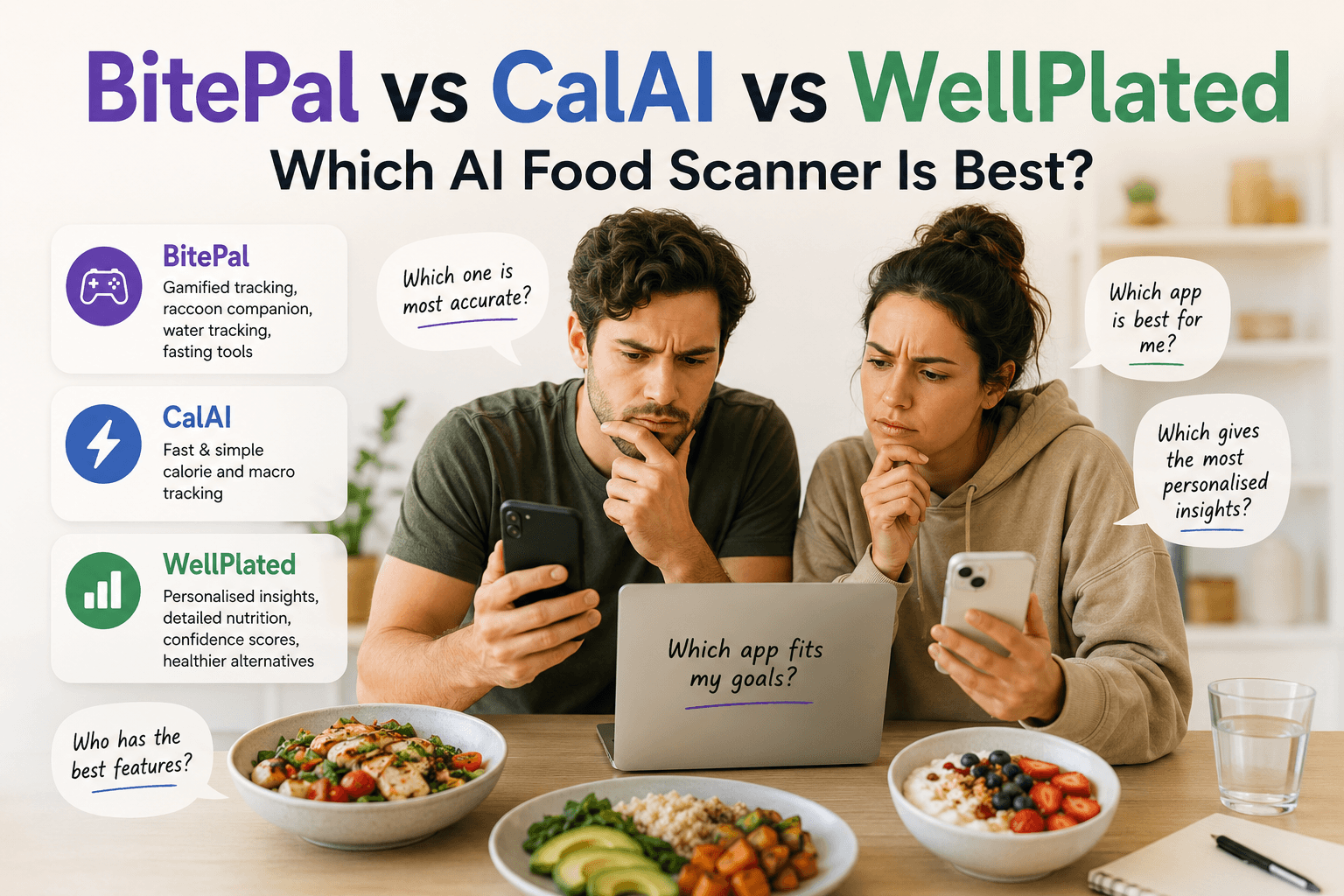
AI food scanning apps are becoming a popular alternative to traditional calorie trackers. Instead of searching a database or typing every ingredient manually, users can now take a photo of a meal, scan a barcode, or log food in a faster way.
But “AI food scanner” can mean different things depending on the app.
Some apps focus on calorie and macro tracking. Some focus on making food tracking feel more fun and habit-based. Others focus on giving more personalised context around meals, goals, preferences, and dietary needs.
In this article, we compare BitePal, Cal AI, and WellPlated.
For transparency, WellPlated is our own app. This comparison is based on publicly available information from app listings, official websites, and WellPlated’s own product functionality. It is not a laboratory accuracy test, and it does not claim that any app is perfect. AI food scanning should always be treated as an estimate, not an exact measurement or medical advice.
Quick summary
BitePal is a gamified AI food tracker. Its App Store listing describes it as a food tracking app with an AI scanner, photo-based meal logging, a nutrition score, key highlights, simple guidance, calorie tracking, water tracking, fasting tools, and a raccoon companion designed to make tracking feel more playful.
Cal AI is focused on fast calorie and macro tracking. Its website says users can snap a photo, scan a barcode, or describe a meal to get calorie and nutrient information. Its App Store listing also describes a simple flow: answer lifestyle questions, snap a meal photo, and receive a nutritional breakdown.
WellPlated is designed around personalised food scanning. It helps users scan food using camera, barcode, photo, or manual entry, then understand meals based on goals, preferences, dietary needs, and optional health needs. It also provides healthier alternatives and aims to give more context than generic labels or scores.
Feature snapshot
BitePal
BitePal appears most focused on making food tracking feel more playful and habit-based.
Key features highlighted publicly include:
AI photo meal scanning
Calorie and macro tracking
Nutrition scores and simple guidance
Water tracking
Intermittent fasting tools
Gamified experience with a raccoon companion
Best suited to users who want food tracking to feel lighter, more engaging, and easier to stick with.
Cal AI
Cal AI appears most focused on fast calorie and macro tracking.
Key features highlighted publicly include:
AI photo meal scanning
Barcode scanning
Meal description logging
Calories, protein, carbs, and fat estimates
Goal-based calorie tracking
A simple, speed-focused logging experience
Best suited to users who mainly want quick calorie and macro estimates with minimal manual input.
WellPlated
WellPlated is designed around personalised food scanning and meal context.
Key features include:
AI photo meal scanning
Barcode scanning
Manual meal logging
Calories and nutrient breakdowns
Goal-aware food insights
Dietary preferences and optional health needs
Healthier alternatives
Personalised meal context
Best suited to users who want food scanning that goes beyond calorie estimates and helps explain how a meal fits their own goals and dietary needs.
This comparison is based on public descriptions for BitePal and Cal AI, plus WellPlated’s current product functionality. App features can change, so users should check each app’s latest listing before subscribing.
BitePal: good for playful habit-building
BitePal appears to be aimed at people who want food tracking to feel lighter and easier to stick with.
Its App Store listing describes BitePal as a gamified food tracking app with an AI scanner. It says users can snap meals, receive a nutrition score, see key highlights, get simple guidance, track calories, monitor water intake, follow fasting windows, and interact with a raccoon companion.
Its Google Play listing also describes BitePal as an AI calorie counter and food tracker that helps users monitor protein, fats, carbohydrates, water intake, and intermittent fasting tools.
That makes BitePal a strong fit for people who struggle with traditional food logging and want something more habit-based. The app’s public positioning is less about deep nutritional analysis and more about making tracking feel simple, friendly, and sustainable.
That is not a weakness. It is simply a different product focus.
Best fit: users who want AI food tracking with gamification, water tracking, fasting tools, and a more playful experience.
Cal AI: good for fast calorie and macro tracking
Cal AI is positioned very clearly around speed and simplicity.
Its website says users can snap a photo, scan a barcode, or describe a meal to get calorie and nutrient information. It also says Cal AI calculates calories, protein, carbs, and fat, and can use a phone’s depth sensor to help calculate food volume.
Its App Store listing describes the flow as answering lifestyle questions, taking a meal photo, and receiving a nutritional breakdown. It also states that food scanning analysis results require a subscription and that the app does not offer medical advice.
That makes Cal AI a strong option for users whose main goal is to log meals quickly and track calories and macros with less manual effort.
Based on its public positioning, Cal AI appears most focused on:
calories
protein
carbs
fat
meal photo analysis
calorie and nutrient goals
speed and convenience
People who mainly want fast calorie and macro estimates may find that useful. People who want broader personalised nutrition context around dietary needs, allergens, salt, saturated fat, or specific health considerations should compare the current app features carefully before subscribing.
Best fit: users who want quick calorie and macro tracking from photos, barcodes, or meal descriptions.
WellPlated: built for personalised food context
WellPlated is designed around a slightly different question.
Not just:
“How many calories are in this?”
But:
“How does this meal fit my goals, preferences, and dietary needs?”
WellPlated lets users scan food using a camera, barcode, photo, or manual entry. It provides a breakdown of what is in the food, gives insights tailored to goals and optional health needs, and provides realistic healthier alternatives.
That makes WellPlated less of a pure calorie-counting tool and more of a food understanding app.
WellPlated is intended for users who want to:
scan meals using a photo
scan packaged foods by barcode
log meals manually when needed
see nutritional information in context
understand how a meal fits their goals
factor in dietary needs and preferences
receive healthier alternatives where appropriate
avoid relying only on generic traffic light labels or generic scores
This matters because nutrition is rarely one-size-fits-all. A meal that works well for one person may not work as well for someone with different goals, dietary preferences, allergies, or health considerations.
WellPlated should still be treated as an estimation tool. Like every AI food scanner, it cannot guarantee exact nutrition from a photo. Hidden oils, sauces, dressings, cooking methods, ingredient quantities, and portion sizes can all affect the result.
The more honest approach is to show users useful context while making it clear that food scanning is not a substitute for weighing ingredients, checking packaging, or following medical advice.
Best fit: users who want AI food scanning combined with personalised nutrition context, barcode/manual logging, healthier alternatives, and goal-aware meal insights.
The key difference
The simplest way to separate the three apps is this:
BitePal appears strongest for users who want food tracking to feel more fun and habit-based.
Cal AI appears strongest for users who want fast calorie and macro estimates.
WellPlated is designed for users who want food scanning with more personalised meal context.
None of those approaches is automatically “better” for everyone. The right choice depends on what the user is trying to achieve.
Someone focused mainly on calorie and macro tracking may prefer Cal AI.
Someone who finds food tracking boring may prefer BitePal’s gamified approach.
Someone who wants to understand meals in relation to their own goals, preferences, dietary needs, and optional health needs may prefer WellPlated.
Important note about AI food scanning accuracy
AI food scanning can be useful, but it should not be treated as exact.
A photo can help identify visible food, but it cannot always know:
how much oil or butter was used
what ingredients are hidden underneath
how a sauce was made
the exact portion weight
whether a food was cooked in a particular way
whether a packaged item has changed its recipe
whether a meal contains an allergen unless that information is clearly provided or detectable
For that reason, AI food scanner results should be treated as informed estimates. They can help users make better-informed decisions, but they should not replace medical advice, allergy advice, or professional dietary guidance.
This is especially important for people with allergies, medical conditions, eating disorders, or strict dietary requirements.
Which app should you choose?
Choose BitePal if you want a food tracking app that feels more playful, with AI photo scanning, calorie and macro tracking, water tracking, fasting tools, and a gamified experience.
Choose Cal AI if your main priority is quick calorie and macro tracking from photos, barcodes, or meal descriptions.
Choose WellPlated if you want AI food scanning that goes beyond calorie estimates and gives more personalised context around your goals, preferences, dietary needs, optional health needs, and healthier alternatives.
Final verdict
BitePal, Cal AI, and WellPlated all sit in the AI food tracking space, but they appear to prioritise different things.
BitePal focuses on playful habit-building.
Cal AI focuses on fast calorie and macro tracking.
WellPlated focuses on personalised food scanning and meal context.
The best choice depends on what the user needs from a food scanner. For users who want more than a calorie estimate, and who want food analysis shaped around their own goals and dietary needs, WellPlated is designed to offer a more personalised route.
This article is for general information purposes only and does not constitute medical advice. Always consult a qualified healthcare professional for guidance specific to your health.